ISITMAXElectric Heating Systems
Room and living room floor heating — 150 W/m² electric heating cable laid beneath screed
Floor Heating

Room and Living Room Floor Heating

Room and Living Room Floor Heating is a system that heats the floor of a living room, bedroom, study or hallway with a 150 W/m² electric heater buried in the screed.

Article no.: ISX-YZ-ODA-SALON Category: Floor Heating
Indicative price · from
€225 / $260

Indicative ex-works İstanbul price, excluding VAT, freight and duties. Converted from the TRY list price at the rate shown; confirmed on the quotation.
rate as of: 2026-09-15

Available sizes

  • TMax cable + fixing strip
  • EasyMat ready-made matting

Available sizes

  • Analogue thermostat
  • Digital touch thermostat
  • Wifi thermostat

Available sizes

  • 2 m2
  • 3 m2
  • 4 m2
  • 5 m2
  • 6 m2
  • 7 m2
  • 8 m2
  • 9 m2
  • 10 m2
  • 11 m2
  • 12 m2
  • 13 m2
  • 14 m2
  • 15 m2
  • 16 m2
  • 17 m2
  • 18 m2
  • 19 m2
  • 20 m2
  • 21 m2
  • 22 m2
  • 23 m2
  • 24 m2

Overview

Room and Living Room Floor Heating is a system that heats the floor of a living room, bedroom, study or hallway with a 150 W/m² electric heater buried in the screed. What sets it apart from the bathroom and kitchen versions is this: 150 W/m² is the standard step determined for use as the main heating in living spaces. The floor temperature is set between 22 and 25 °C from a thermostat whose sensor is embedded in the screed. As the heater you choose either TMax cable fixed to a strip or EasyMat mat with the cable arranged on mesh; the two are the same cable and cost the same. The product is prepared between 2 and 24 m², in steps of one square metre.

In a bedroom, the room and living room floor heating system is turned down at night and brought back on towards morning; set the programme not for the time you wake but a little before it. The reason is the thermal inertia of the screed: the heater warms quickly, but because the screed stores the heat and releases it upwards, the system is slow to warm and slow to cool. The floor takes 20–40 minutes to reach a noticeable temperature.

At a glance

150 W/m², matched to living spacesThe step for living rooms, bedrooms, studies and hallways; the floor is held at 22–25 °C.
2–24 m², in one square metre stepsFrom a hallway strip to a large living room. Above 12 m² the floor becomes two zones.
20-year warranty on the heating element20 years on TMax cable and EasyMat mat; 2 years on the thermostat, strip and underlay.
Our own manufacture since 1995CE-certified manufacture, shipping and service throughout Türkiye. Monday–Saturday, 09:00–17:00.

Where it is used

TMax cable + fixing strip

You set the laying spacing

TMax cable + fixing strip It runs at roughly 10 cm spacing, clipped into the teeth of a plastic strip fixed to the floor; an average of 10 metres of cable is used per square metre. In a narrow hallway and around columns it turns down to a 30 mm bending radius.

EasyMat ready-made matting

Shortens the laying work in large living rooms

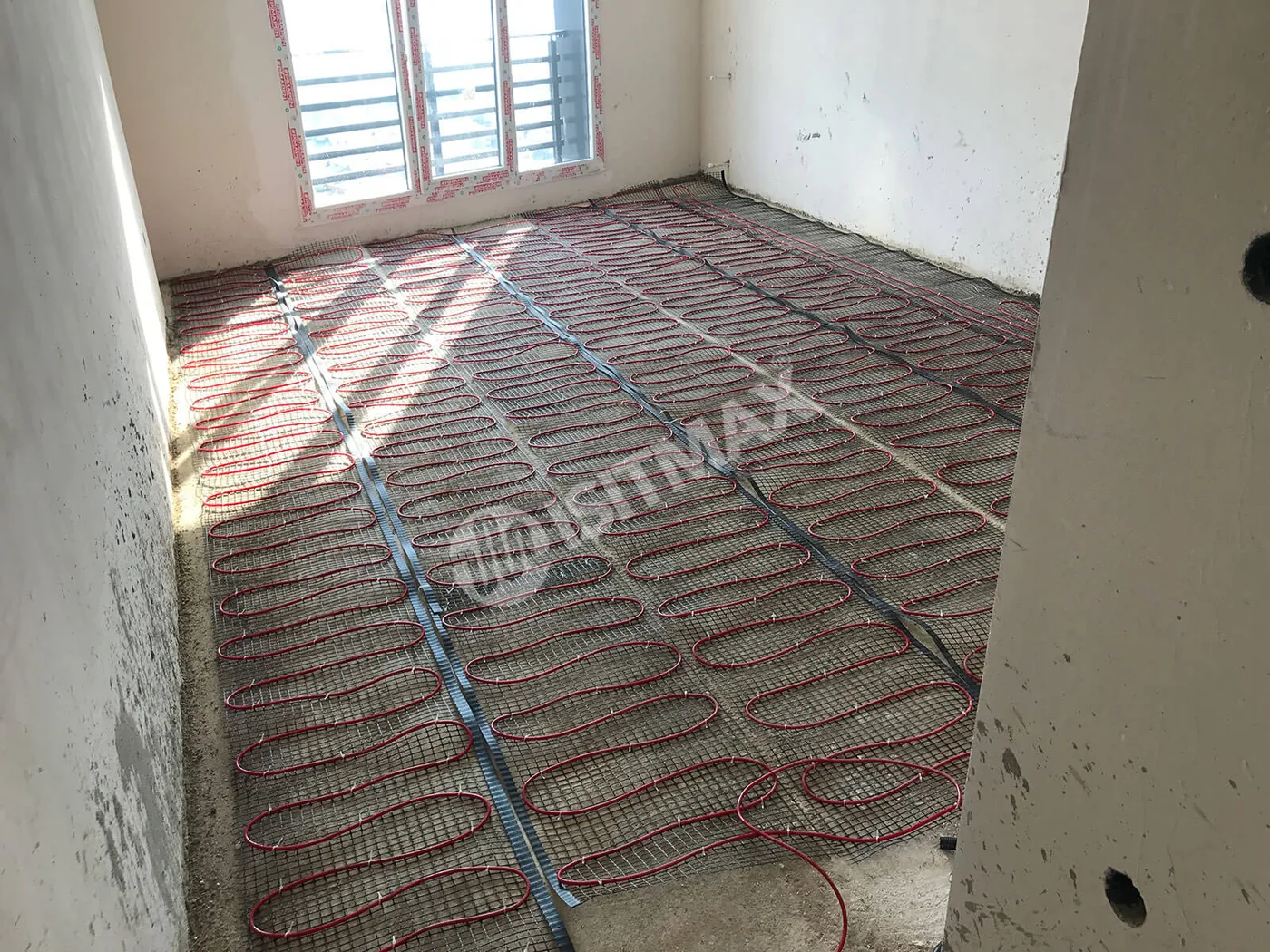
EasyMat ready-made mat The cables are stitched onto a stiff fibreglass mesh at the correct spacing at the factory; it comes in 50 and 100 cm widths and 6 mm thickness. Unrolling it and sticking it down is all that is needed; at turns the mesh is cut and the cable never is.

Technical specifications

PropertyValue
Product type, code, area rangeRoom and living room floor heating system, beneath screed, HomeMax · ISX-YZ-ODA-SALON · 2 – 24 m², in steps of one square metre
Heater type and powerTMax cable + fixing strip · EasyMat ready-made mat · 150 W/m²TMax is single-conductor, series (fixed) resistance; the unit price is the same
Cable and matting dimensionsan average of 10 m of cable per 1 m² · ~10 cm spacing · 6 mm diameter · minimum bending radius 30 mm · mat in 50 and 100 cm widths, 6 mm thick, stiff fibreglass mesh, 3 m cold lead
Supply and cable construction220 – 240 V AC, 50 Hz · IP67 · two layers of polymer insulation · 100% earth protection · 100% EMI screening · armoured · UV and FR resistant · anti-ageing · max. +65 °C
Floor temperature and warm-upTarget 22 – 25 °C · maximum 45 °C · first warm-up 20 – 40 minutesshorter on a floor with underlay
Compatible coveringsCeramic, porcelain, marble, natural stone, laminate and solid parquet, vinylparquet and vinyl are laid over the screed
Screed, level, laying distancesAt least 3 cm of screed, ideally 3 – 5 cm · a level rise of roughly 3 cm · 5 – 10 cm in from the wall · 10 – 20 cm clear of fixed furniture · at least 5 cm between two runs
Thermostat and zoningAnalogue · digital touch · digital wifi · 16 A · a single thermostat up to 12 m²sensor and installation conduit included · two thermostats for 24 m²
Protection, certification, warranty30 mA residual current device mandatory · ohm test before screeding · CE-certified manufacture · 20 years on the heating element2 years on the thermostat, fixing strip and underlay

Selection guide

How is the heated area for room and living room floor heating calculated, and is the area under furniture heated?

Room and living room floorHeated?Reason
Wardrobe, bookcase, TV unit sitting flush with the floorNoClosed base, no air circulation, heat is trapped
A suite that sits on the floor and a divan bedNoThe carcass covers the floor and a thermal bridge forms
The area in front of a fireplace hearth and a permanent rug areaNoOne is already a heat source, the other adds the resistance of a rug; both stay outside the area
Under a bed frame on legs and a sofa on legsYesThe air gap prevents heat from building up
Room entrance, hallway, seating areaYesOpen floor; the longest part of the day is spent here
Around the bed, at the table and in front of the windowYesFeet rest on the floor and the cold coming off the glass is balanced out

Is this the right product?

A good fit when

  • You will heat a living room, bedroom, child's room, study or hallway with room and living room floor heating.
  • With the areas under furniture deducted, your heated area comes out between 2 and 24 m², and you want to remove the radiator and free up the wall.
  • At least 3 cm of screed can be poured on the floor and you have room for a level rise of about 3 cm; ceramic, marble, parquet or vinyl will go on top.
  • You want this system to provide the main heating for the room, and you understand that if your insulation is poor the system will run for longer and consumption will rise accordingly. Your circuit has a 30 mA residual current device or you can have one fitted.

Not the right choice when

  • If you cannot lay screed or do not want to lift the parquet — carbon heating film is the better choice: 200 W/m², under 1 mm thick, 2-year warranty.
  • If the space you are heating is a bathroom — bathroom floor heating is calculated at 180 W/m².
  • If you are heating the kitchen only — kitchen floor heating is laid out around units and built-in appliance recesses.
  • If you are heating a balcony or terrace — a semi-open space calls for 200 W/m²: the conservatory and terrace floor heating mat.
  • If you expect the monthly heating cost to be independent of the condition of the building — the power step is standard, but in a poorly insulated home the system runs for longer and consumption rises.

Installation

  1. Preparation and marking outThe floor is swept; it must be dry and even. The areas that will not be heated — wardrobe, bookcase, divan base, a sofa sitting on the floor, the fireplace hearth — are marked out; the heater starts 10–20 cm clear of these and 5–10 cm in from the wall. The underlay is laid at this step; if you have chosen cable, the strips are fastened with screws or adhesive.
  2. Laying the heaterThe TMax cable is seated in the teeth of the strip at roughly 10 cm spacing, and the 30 mm bending radius is never gone below. With EasyMat mat the roll is unrolled and fixed with tape; at turns only the mesh is cut. Two runs must never come closer than 5 cm to one another — cables that touch overheat. The sensor, in its conduit, is placed midway between two runs.
  3. Electrical connection, screed and finishA qualified electrician connects the thermostat and the sensor, and an ohm test is carried out before screeding. If the test is passed, at least 3 cm of screed is poured; 3–5 cm is ideal, as this range lets the screed store heat. Once the screed has dried, the covering is laid.
The most common mistake when pouring screed. Mortar mixed too stiff and tipped straight onto the heater pushes the cables aside and destroys the laying pattern. The mortar must be of a runny consistency and must contain no aggregate such as crushed stone; no stacks of floor tiles, marble slabs or machines with hard feet should be set down on it.

Ordering and delivery

  1. same dayHeater type, thermostat and area are selected and the order placed
  2. 1 working dayA dimensioned sketch of the room arrives and the area is confirmed
  3. 1 working dayThe heater is prepared and the cold lead is brought out towards the thermostat wall
  4. 2–4 working daysHandover to the carrier, a tracking number and shipping throughout Türkiye
  5. as requiredTechnical support with laying, the ohm test and setting the thermostat

Warranty and support

ISITMAX has manufactured electric heating products in its own facility since 1995. Room and Living Room Floor Heating is our own CE-certified manufacture and part of the HomeMax floor heating family; we ship throughout Türkiye.

Frequently asked questions

Can room and living room floor heating heat the home on its own?
It can. 150 W/m² is the standard step determined for use as the main heating in living spaces; this figure does not go up or down with the condition of the building. Insulation, climate and frequently opened windows do not change the heater's output — they lengthen the time it stays switched on, and so determine monthly consumption. Underlay and a weekly programme are the most practical way of shortening that time.
My living room is 20 m² — how many square metres should I select?
Select not the total area but the open floor that remains once the areas under furniture are deducted. For example, in a 20 m² living room where the wardrobe takes 2 m² and the TV unit 1 m², you deduct 3 m² and select the remaining 17 m². Because the heater starts 5–10 cm in from the wall, 8 m² is usually right for a 10 m² room.
Is the heater laid under sofas and beds?
What matters is whether the furniture sits flush with the floor. It is not laid under wardrobes, bookcases, divan bases or sofas that sit on the floor; a thermal bridge forms beneath a closed carcass. There is no problem under bed frames and sofas on legs — the air gap prevents heat from building up.
Can room and living room floor heating be laid beneath laminate flooring?
Yes, but not directly beneath the parquet — it is laid beneath a protective screed: the heater is covered with at least 3 cm of screed and the parquet goes over the screed. The parquet manufacturer must have approved it for floor heating. Beneath laminate the surface temperature is never taken above 25 °C; if laminate stays above this figure for a long time it can swell and come apart. With solid timber, 1 cm is the practical thickness limit.
Should the system stay on overnight in a bedroom?
Turning it down at night and bringing it back on towards morning is the most efficient arrangement; because the screed stores heat, the system is slow to warm and slow to cool. Set the morning programme 20–40 minutes before you wake; this arrangement is only possible with a digital or wifi thermostat.

Related products

Floor Heating

Bathroom Floor Heating

Bathroom floor heating warms a ceramic or tiled bathroom floor with a 180 W/m² electric heater embedded in the screed.

from €235 $270View product →
Floor Heating

Fibreglass Fixing Tape

Fibreglass fixing tape is a high-temperature consumable that holds a heating cable at even spacing and stops it moving on the surf

from €5 $10View product →
Floor Heating

Hammam Floor Heating

Hammam floor heating warms the walking area, seating area, backrest area and navel stone of a hammam with a 240 W/m² electric heat

from €270 $310View product →

Request a quote

Tell us the application and we will size the system and quote it.