ISITMAXElektrische Heizsysteme
Kitchen floor heating — electric heating system laid in the working strip in front of the worktop
Fußbodenheizung

Kitchen Floor Heating

Kitchen floor heating works with a 150 W/m² electric heater buried beneath the ceramic covering of the kitchen floor.

Artikel-Nr.: ISX-YZ-MUTFAK Kategorie: Fußbodenheizung
Richtpreis · ab
€225 / $260

Richtpreis ab Werk Istanbul, zzgl. MwSt., Fracht und Zoll. Umgerechnet vom TRY-Listenpreis zum angegebenen Kurs; verbindlich erst im Angebot.
Kurs vom: 2026-09-15

Verfügbare Größen

  • TMax cable + fixing strip
  • EasyMat ready-made matting

Verfügbare Größen

  • Analogue thermostat
  • Digital touch thermostat
  • Wifi thermostat

Verfügbare Größen

  • 2 m2
  • 3 m2
  • 4 m2
  • 5 m2
  • 6 m2
  • 7 m2
  • 8 m2
  • 9 m2
  • 10 m2
  • 11 m2
  • 12 m2

Überblick

Kitchen floor heating works with a 150 W/m² electric heater buried beneath the ceramic covering of the kitchen floor. It heats the floor without giving up space to a radiator: because the walls are covered with units, it moves the entire heating load onto the floor. The target floor temperature is set between 22 and 25 °C from a thermostat whose sensor is embedded in the screed. There are two options for the heater: TMax cable laid and fixed to a strip, or EasyMat mat with the cable arranged on mesh at the factory. The cable inside the two is the same, delivers the same power and is sold at the same price per square metre. The product is prepared for areas between 2 and 12 m².

The real reason for kitchen floor heating is space: almost every wall is taken up by units, worktop, extractor hood and built-in appliances, and there is no gap left to hang a radiator. Because floor heating puts the heater under the floor, it takes up not a single centimetre of wall; you arrange the kitchen around how you use it, not around the heater. It is also the answer for anyone who wants to remove an existing radiator and put a cupboard in its place.

Auf einen Blick

150 W/m² for kitchen floor heatingA kitchen is a living space, not a wet room. This is the power calculated for use beneath ceramic; the floor is held in the 22–25 °C band.
No price difference between cable and matThe cable inside the two is the same and both deliver 150 W/m². The decision is made by your kitchen's floor plan, not by your budget.
20-year warranty on the heating element20 years on TMax cable and EasyMat mat; 2 years on the thermostat, fixing strip and underlay.
In our own facility since 1995CE-certified manufacture. We ship throughout Türkiye. Technical support Monday–Saturday, 09:00–17:00.

Einsatzbereiche

TMax cable + fixing strip

The laying spacing is yours to set; it fits into every gap

TMax cable + fixing strip It runs at roughly 10 cm spacing, clipped into the teeth of a plastic strip fixed to the floor. It goes around the island, enters the narrow band in front of the worktop in a single row and skips appliance recesses; at the tightest turn it comes down to a 30 mm bending radius. The strip is included in the square metre price.

EasyMat ready-made matting

Unroll it, stick it down, done

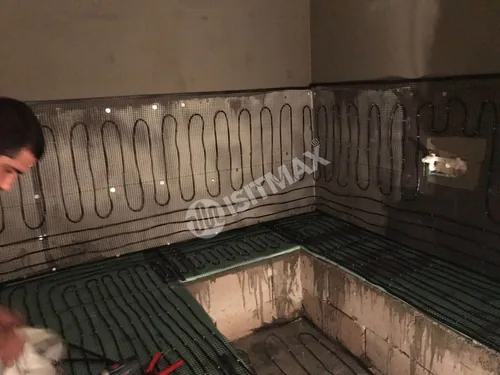
EasyMat ready-made mat The cables are arranged on mesh at the correct spacing at the factory; you unroll it and stick it down, with no spacing to measure. It comes in 50 cm and 100 cm widths; on an open, flat floor the laying takes minutes. When changing direction only the mesh is cut, never the cable.

Technische Daten

PropertyValue
Product, code, area, outputKitchen floor heating system, beneath ceramic, HomeMax · ISX-YZ-MUTFAK · 2–12 m², in 1 m² steps · TMax cable + fixing strip or EasyMat ready-made mat · 150 W/m²TMax is single-conductor with series (fixed) resistance; the unit price is the same for both types.
Dimensions and supplyan average of 10 m of cable per 1 m² · roughly 10 cm laying spacing · roughly 6 mm diameter · minimum bending radius 30 mm · mat in 50 and 100 cm widths · 220–240 V AC, 50 Hz · IP67On the mat the laying spacing is set at the factory.
Suitable finishesCeramic, tile, porcelain, marble, natural stoneCarbon heating film is used for parquet and laminate.
Temperature and warm-upTarget floor temperature 22–25 °C · thermostat upper limit 45 °C · initial warm-up 20–40 minutesWarm-up time depends on screed thickness; with underlay it is roughly 30% shorter.
Screed, build-up and insulationat least 3 cm of screed over the heater · a rise of roughly 3 cm in the floorThe underlay is a separate product; İzoMax 7 mm is recommended.
Thermostat and protectionAnalogue · digital touch · digital wifi, together with a floor sensor · 1 unit up to 12 m², 2 units up to 24 m² · 30 mA residual current device mandatory · ohm test before screedingThe heating circuit is fed separately from the fuse for the built-in appliances.
Conformity and warrantyOur own CE-certified manufacture · 20-year warranty on the heating elementThe thermostat, fixing strip and underlay carry a 2-year warranty.

Auswahlhilfe

TMax cable or EasyMat matting?

AspectTMax cableEasyMat matting
Heater, output and priceSingle-core, series resistance · 150 W/m² · fixing strip includedThe same cable, on mesh · 150 W/m² · the same price
Island, recess and narrow stripGoes around the island and enters the narrow strip in front of the worktop in a single rowThe mesh is cut and turned; the roll width may not fit a narrow strip
Laying time, risk of error, warrantyTakes longer · spacing must be measured · 20 yearsQuick · no spacing errors · 50 and 100 cm widths · 20 years

Ist dies das richtige Produkt?

Passend, wenn

  • You are considering kitchen floor heating and the floor will be covered with ceramic, tile, porcelain, marble or natural stone.
  • With the areas under units and appliances deducted, your heated area comes out between 2 and 12 m².
  • At least 3 cm of screed can be poured beneath the covering and you have room for the floor to rise by about 3 cm.
  • You have no free wall to hang a radiator on, or you want to remove the existing radiator.
  • You are looking for a solution that needs no boiler or plumbing; your supply circuit has a 30 mA residual current device or you can have one fitted.

Nicht geeignet, wenn

  • If the kitchen floor is to be laid with parquet or laminate. Cable and mat are buried in the screed, not under parquet. A thin solution that needs no screed is required: carbon heating film laid beneath parquet. With laminate the rule is clear: if the surface stays above 25 °C for a long time, the boards swell and come apart at the joints.
  • If your kitchen opens onto the living room and you will heat both spaces with a single system. This product's range ends at 12 m². For an open plan, room and living room floor heating in the 2–24 m² range is the right choice; the power is again 150 W/m².
  • If your heated area exceeds 12 m². A single thermostat cannot manage this area; a two-zone installation is required.
  • If you want to leave the existing ceramic in place, or to heat the whole floor including the island. The system goes beneath the covering, and the areas under the island and the units are technically not heated.
  • If you will lay a permanent rug or kitchen mat in front of the worktop. A woven layer acts as thermal resistance on top of the floor; no heater is laid beneath it and that strip is kept outside the heated area.

Installation

  1. PreparationThe floor is swept; it must be dry and even. If you are using insulation underlay, it is laid at this stage. If you have chosen cable, the fixing strips are fastened to the floor. The areas that will not be heated — the run of units, the island footprint, the appliance recesses — are marked on the floor.
  2. Laying the heaterThe TMax cable is seated in the teeth of the strip at roughly 10 cm spacing; it is guided around the island and along the edges of recesses, and even at the tightest turn the 30 mm bending radius is not forced. With EasyMat mat the roll is unrolled onto the floor and stuck down; when turning back only the mesh is cut, never the cable. The floor sensor, in its protective conduit, is placed midway between two runs.
  3. Electrical connection and screedA qualified electrician connects the thermostat and the floor sensor; an ohm test is carried out before the screed is poured. If the test is passed, at least 3 cm of screed is poured and ceramic is laid over it — together they raise the floor by about 3 cm.
Electrical safety — four points. One: the supply must be 220–240 V AC 50 Hz and the circuit must be protected by a 30 mA residual current device; this protection is not optional. Two: the ohm test is carried out before the screed; if the resistance is outside the expected range the screed must on no account be poured, because after screeding a fault can only be found by breaking up the floor. Three: a qualified electrician makes the connection — stop at this step even if you did the laying yourself. Four, the one specific to kitchens: the heating circuit is not connected to the same fuse as the built-in oven, hob and dishwasher; these appliances already draw a high current, and the heating system is fed from its own fuse.

Bestellung und Lieferung

  1. same dayHeater type, thermostat and heated area are selected and the order placed
  2. 1 working dayA dimensioned sketch of the kitchen is sent in and the wall where the thermostat will go is marked
  3. 1 working dayThe heater is prepared to the project and the leads are brought out at the correct point
  4. 2–4 working daysHanded over to the carrier and the tracking number shared — delivery throughout Türkiye
  5. as requiredTechnical support is provided during laying and when setting the thermostat

Garantie und Support

Kitchen Floor Heating is a CE-certified product of ISITMAX's own manufacture, carried on since 1995, and belongs to the HomeMax floor heating family. We ship throughout Türkiye.

Häufige Fragen

How many m² should I buy for kitchen floor heating?
Select not the total floor area of the kitchen but the open floor that remains once the areas under units and appliances are deducted. The run of units, the island unit and the areas under the built-in oven, dishwasher and refrigerator are excluded; the strip in front of the worktop, the kitchen entrance, the area around the island, the dining table area, the coffee corner and the window edge are included. Example: in a 12 m² kitchen where the area under the units is 3 m² and under the appliances 1.5 m², you deduct 4.5 m² and select 8 m² for the remaining 7.5 m².
Are the areas under the worktop and units heated?
No. No heater is laid beneath the run of units, the island unit or fixed furniture that sits flush with the floor; heat cannot rise under a closed carcass. Only the open floor that is walked on is heated.
How much electricity does kitchen floor heating use?
Over an 8 m² heated area at 150 W/m² the connected load is 1,200 W; if the system runs 6 hours a day, monthly consumption comes to roughly 216 kWh. To find the monthly cost, multiply this figure by the unit price on your bill. The number is a ceiling: the thermostat cuts the system once it reaches the target, so it does not run for 6 hours without a break — with underlay and a programmable thermostat, actual consumption falls markedly.
For kitchen floor heating, is cable or mat better?
Cable is the more common choice in kitchens, because a kitchen floor is broken up by units, the island and appliance recesses; cable works its way around these gaps without being cut. Mat, on the other hand, is laid within minutes on a wide, flat floor. The cable inside the two is the same, delivers 150 W/m² and is sold at the same price per square metre.
Can I install kitchen floor heating myself?
The heater yes, the electrical connection no. Laying the underlay, fixing the strips and laying the heater are jobs you can do with the illustrated manual that comes in the box. The thermostat, sensor and fuse connections are made by a qualified electrician; the whole job is finished in half a day.

Ähnliche Produkte

Fußbodenheizung

Hammam Floor Heating

Hammam floor heating warms the walking area, seating area, backrest area and navel stone of a hammam with a 240 W/m² electric heat

ab €270 $310Produkt ansehen →

Angebot anfordern

Beschreiben Sie die Anwendung — wir legen das System aus und erstellen ein Angebot.